
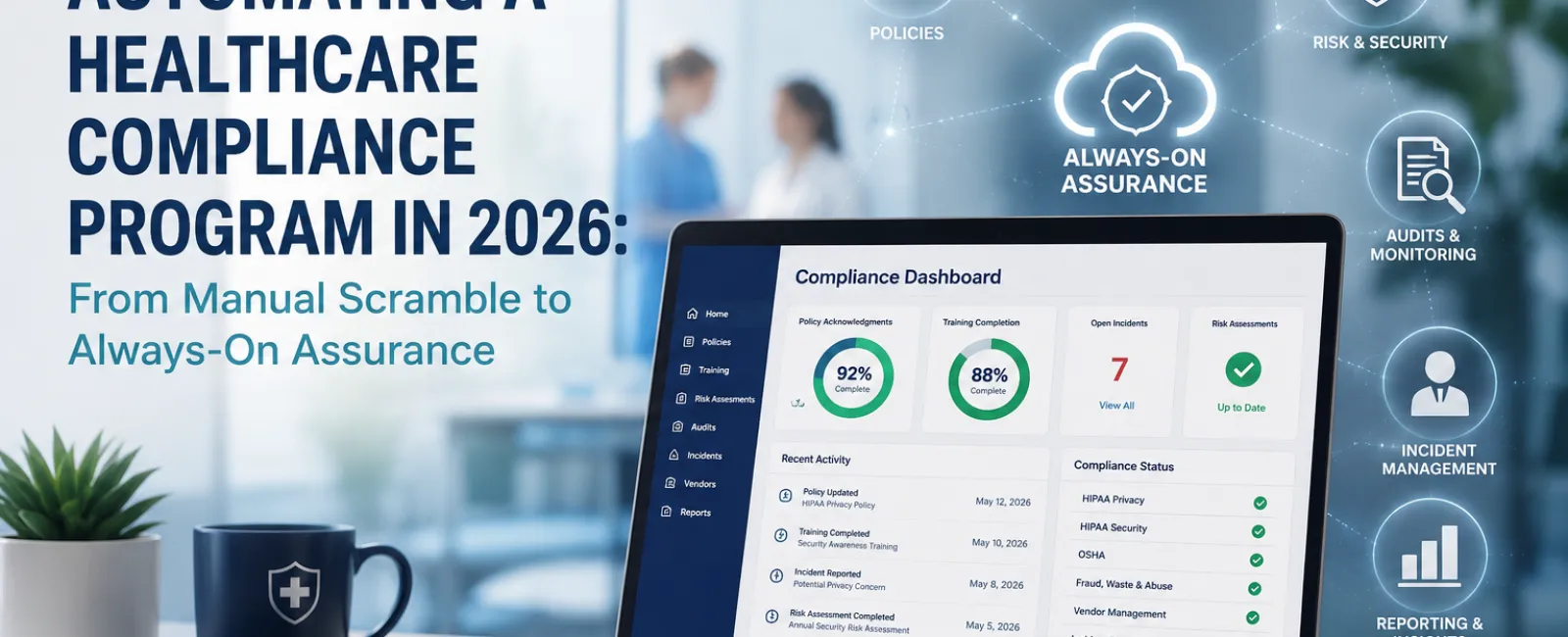
Healthcare organizations in 2026 face an expanding web of regulation, technology, and care models, while enforcement continues to increase. Manual paper and spreadsheet‑driven compliance programs struggle to keep pace. Automation—done thoughtfully—can turn compliance from a reactive exercise into a continuous, auditable process built into daily operations.
In this article, we will explain how to modernize and
automate your healthcare compliance program in 2026, with a focus on:
- AI
visibility and oversight
- Workflow
automation across key compliance processes
- Internal
audits and monitoring
- Selecting
the right automation tools
- Automating
compliance training
- Optimizing
day‑to‑day compliance tasks
- Regulatory
and ethical considerations
Using the OIG's General Compliance Program Guidance (GCPC)[1]
and other regulatory resources as the foundation, we will align core compliance
expectations with modern tools to help decrease the manual burden compliance
imposes on healthcare organizations.
1. Start from the Core: What a "Good" Compliance Program
Looks Like
Automation only works if it is mapped to a sound compliance
framework. The HHS Office of Inspector General (OIG) describes seven core
elements that remain the backbone of an effective healthcare compliance
program:
- Written
policies, procedures, and standards of conduct
- Compliance
leadership and oversight (including a designated compliance officer and
committee)
- Effective
training and education
- Effective
lines of communication
- Enforcing
standards through well‑publicized disciplinary guidelines
- Risk‑based
auditing and monitoring
- Prompt
response to detected problems and corrective action
OIG's GCPG consolidates prior guidance and emphasizes that
organizations should tailor these elements to their size, risk profile, and
operational realities. In 2026, "tailoring" a healthcare compliance program simply
means making it applicable and actionable for your specific organization. Today's
digital landscape makes maintaining a manual compliance program and completing
compliance tasks nearly impossible without help from technology. It is more important now than ever before to
build automated controls, evidence collection, and alerts into the processes
that support each element of the compliance program. Rather than treating them
as a separate, manual overlay it is time to streamline and automate compliance
into daily business processes.
A useful starting exercise is to map each of your existing
program elements to determine:
- Where
the underlying work actually happens (EHR, billing, HR,
credentialing, training systems, etc.)
- Who
owns the work operationally (i.e.—who is accountable for it)
- What
evidence each functional area currently generates
- How the
evidence is maintained
This map then becomes your blueprint for automation.
2. AI Visibility and Oversight: See Every AI Touchpoint
Many healthcare organizations are piloting or using AI in clinical decision support, documentation, scheduling, revenue cycle, and patient engagement. Federal regulatory bodies are becoming increasingly vocal about AI governance and monitoring and no longer treating it as an invisible back‑office feature.
Why AI visibility belongs in your compliance program
Recent regulatory findings show what can go wrong when AI is deployed without a formal safety and reporting process.[2] In a review of generative AI tools at the Veterans Health Administration, the VA Office of Inspector General found that AI chat tools were being used for clinical care and documentation without a coordinated process to report, track, and respond to AI‑related safety issues. The absence of structured feedback and review process limited the organization's ability to detect patterns, improve tools, and mitigate risks.
Meanwhile, analyses of AI in healthcare emphasize that
regulators must balance innovation with safety, and call for clear
accountability, standards, and governance mechanisms across the AI lifecycle.
For compliance leaders, that translates into three automation‑ready
expectations:
- Maintaining
an inventory of AI tools used across the organization,
including their purpose, data inputs, outputs, and responsible owners.[3]
- Implementing monitoring
and incident reporting channels specifically for AI‑related
safety or quality issues.
- Ensuring human‑in‑the‑loop
oversight and clear escalation paths for high‑risk AI uses. (i.e.
patient care, medical decision making, etc.)
How to automate AI visibility
You can embed AI oversight into your compliance workflows
with relatively simple automation patterns, including:
- AI
system registry
- Maintain
a structured catalog (e.g., in a GRC platform) of all AI tools and models
used in clinical, operational, or compliance activities—including risk
categorization and approvals.
- Trigger
automated reminders for periodic reviews, performance checks, and
reapproval when models or use cases change.
- Automate
intake and risk screening
- Route
any new AI project through an online request form that captures use case,
data types (especially PHI), intended users, and external vendors.
- Implement
automated notifications for compliance, privacy, security, and clinical
governance reviewers based on the risk profile.
- Event
logging and monitoring
- Require
AI tools to log key interactions and decisions in a way that can be tied
to clinical or operational records. This enables retrospective review if
safety concerns arise.
- Feed
AI‑related incidents into your existing patient safety, quality, and
compliance incident systems so they are not analyzed in isolation.
These steps turn AI from a "black box" into a governed, auditable set of capabilities that sit within your broader compliance and risk framework.
3. Workflow Automation for Compliance Activities
Most healthcare compliance risk arises from daily
operations: ordering, documentation, coding, billing, privacy practices,
infection control, and more. The GCPG underscores that risk‑based auditing and
monitoring should be built around these operational processes. Automation helps
ensure those processes consistently follow policy and produce the evidence you
need.
Map processes to controls and evidence
Using the OIG's guidance, you can identify high‑risk
processes and design workflows that "bake in" controls in such areas as:
- HIPAA‑related
workflows (e.g., access requests, breach assessment, sanctions)
- Billing
and coding workflows (e.g., high‑risk service lines, modifiers,
telehealth)
- Quality
and patient safety workflows (e.g., incident reporting, infection control)
- HR
and credentialing workflows (e.g., exclusion checks, license verification)
For each high-risk control, ask:
- What
regulatory or program requirement is at stake if something goes wrong?
- What
control should alert automatically (e.g., approvals, data checks,
segregation of duties)? Who should
receive the alert?
- What evidence will
auditors expect from my organization (log entries, timestamps, approvals,
data snapshots, investigation reports, RCA)?
Consider these examples of automated compliance workflows:
- Pre‑claim
checks in billing
- Automate
flags for combinations of codes, modifiers, or frequencies associated
with historical enforcement actions described in OIG compliance guidance.[4]
- Route
flagged claims for secondary review before submission
- Keep
a system‑generated log of decisions
- Exclusion
and license monitoring
- Automatically
query federal and state exclusion lists and licensing boards monthly for
all workforce members, contractors, business associates, and vendors.
- Log
results and create an auto notification to the compliance officer if a match
is found.
- Privacy
incidents and breaches
- Use
structured reporting for suspected privacy incidents that trigger
automated classification, initial risk scoring, and assignment to the
compliance officer for investigation.
- For
smaller organizations, use of an anonymous online form with automated
email notifications is one potential alternative.
- Ensure
the reporting system captures timeframes needed to assess timeliness
obligations under federal and state notification rules.
4. Internal Audits and Continuous Monitoring
The OIG stresses that effective compliance programs must
incorporate both auditing (periodic, risk‑based reviews)
and monitoring (ongoing checks built into operations).
Automation can greatly enhance both your auditing and monitoring
processes. Consider the following:
Designing an automated internal audit plan
A modern audit plan can be driven by:
- Risk
assessments aligned with the GCPG and industry‑specific compliance
program guidance documents.
- Conducting
a Security Risk Analysis is a vital piece of this process.
- Signals
from external sources, such as the OIG Work Plan, which highlights
areas of current enforcement focus.
The HHS Listserv is another important resource to consider.
Internal auditing and monitoring can be a time-consuming and
arduous process. However, there are
methods for speeding up these processes.
Here are a few ideas:
- Pre‑built
query templates to sample claims, encounters, or access logs based on
current OIG Work Plan topics.
- Dashboards
that trend error rates or exception volumes over time, prompting deeper
audits when thresholds are exceeded.
- Auto‑generation
of audit workpapers and issue logs as reviewers' complete checklists in
audit tools.
These are only a few examples to consider. The approaches allow the compliance function
to spend more time analyzing patterns and less time pulling data.
Continuous monitoring and exception management
Instead of waiting for annual audits, find ways your systems
can monitor for certain behaviors continuously.
If you have a particular area of focus, you can find audit and
evaluation tools to determine if improvement was made since the last evaluation.
Documenting any improvements and any new or continuing risks that need
addressing is a vital part of an effective monitoring and auditing program.
The OIG expects organizations to respond promptly to
detected problems and to implement corrective actions. Automated exception
queues, task assignments, and follow‑up reminders help ensure each issue is
tracked from detection to resolution, with a clear evidence trail.
5. Selecting the Right Automation Tools
There is no single "compliance automation" system that
covers everything. However, some vendors, such as Healthcare Compliance Pros,
can significantly reduce many of the administrative compliance tasks and
burdens placed on a compliance officer. Remember,
you are assembling a toolkit that supports the OIG's program elements while simultaneously
informing and enforcing HIPAA, OSHA, and other compliance requirements. If the
tools in your toolkit are not going to help your organization, or currently are
not effectively helping you, it's time to replace them with other tools.
Anchor your choices in regulatory expectations
When evaluating tools, ensure they can support:
- Access
controls, audit logs, and integrity safeguards appropriate for
systems handling protected health information or other sensitive data,
consistent with HIPAA Security Rule.
- Evidence
generation that aligns with what OIG expects to see when
assessing program effectiveness (i.e.
documented policies, training records, incident logs, corrective
actions, and monitoring results).
- Configurability so
you can align workflows with the OIG's guidance and your own
policies, rather than adopting generic templates that do not adequately
address your organization's risks.
For AI‑enabled tools, consider whether their use might
implicate FDA oversight, such as "software as a medical device" or other
digital health categories. This introduces additional regulatory obligations
around validation, change management, post‑market monitoring, and device data
security.
Practical categories to consider
While specific product names are not mentioned in this
article, most organizations blend several categories together:
- Governance,
risk, and compliance (GRC) platforms for policies, risk
registers, issue management, and reporting
- Workflow
and case management tools for incidents, investigations, and
approvals
- Audit
and analytics tools capable of sampling and testing data sets
across claims, clinical, and access controls
- Learning
management systems (LMS) that can automate training assignments, recordkeeping,
and reminders
- AI‑assisted
utilities for screening large data sets, detecting anomalies, or
classifying events—as long as they are deployed with strong governance.
The key is not breadth but alignment: every tool should
serve a defined compliance need and integrate with your evidence and reporting
ecosystem.
6. Automating Compliance Training
Training and education is one of the OIG's core compliance
program elements. The GCPG and HIPAA Privacy and Security Rules emphasize the
need for ongoing, role‑appropriate training that covers key laws, policies, and
organizational expectations. Automation can elevate training from an annual
"check the box" event to a targeted, data‑driven program.
Build a data‑driven training cycle
An effective, automated training system will:
- Assign
training curriculum based on role and risk
- Map
job roles to specific training modules (e.g., billing compliance,
privacy, security, research, vendor management, etc.).
- Automatically
assign or adjust training when roles or departments change.
- Incorporate
regulatory and enforcement updates
- When
the Department of Health and Human Services (HHS) issues new compliance
guidance or its subsidiaries update their Work Plans, flag affected
topics and auto‑trigger content reviews and course updates.
- Consider
implementing a continuous review cycle to help your course content stay
up to date, rather than waiting for new guidance to be announced. Your training should also account for internal
updates and changes as well as those issued by a regulatory body.
- Capture
completion and understanding
- Record
completion dates, scores from assessments, and attestations to policies.
- Log
non‑completion or poor performance into compliance dashboards for follow‑up
and potential remediation or intervention.
The OIG's guidance notes that documentation of training is
important both to demonstrate program effectiveness and to support disciplinary
decisions when policies are violated. Automating the collection and retention
of training data simplifies this significantly.
7. Optimizing Daily Compliance Tasks
Much of compliance work involves recurring tasks, such as:
following up on hotline reports, updating policies, performing monitoring
checks, sending training reminders, recording meeting minutes, and more.
Automating the intake, routing, and tracking of these tasks can reduce delays
and blind spots within your compliance program. Here are some examples of
task-level automation that you can apply in your organization:
- Hotline
and reporting intake
- Provide
multiple channels (phone, web, internal portals) that feed into a unified
case management system.
- Automatically
categorize issues (e.g., billing, privacy, HR, research) and route them
to appropriate investigators while preserving confidentiality and non‑retaliation
expectations highlighted in the OIG's guidance.
- Policy
lifecycle management
- Automate,
review, and approval cycles for all compliance policies with reminders
tied to annual or risk‑based indicators.
- Maintain
a versioned repository and automatically notify staff when key policies
change, especially those that impact day‑to‑day workflows.
- Corrective
and preventive actions
- When
monitoring or auditing identifies an issue, generate tasks for
remediation, assign owners, set deadlines, and track completion.
- Link
corrective and preventive action items to their original findings and
store evidence of completion. The OIG recognizes this as part of an
effective response to detected problems.
These and many other compliance patterns allow staff to
focus on judgment‑heavy activities—such as risk assessments, board reporting,
and culture building rather than on manual reminders and tracking.
8. Regulatory and Ethical Considerations for Automation
and AI
While automation can strengthen compliance, it also
introduces new risks. Regulators and scholars emphasize several themes that
should shape your 2026 automation strategy. Appropriate guardrails for AI and
automated decision-making should be analyzed and considered from a
risk-mitigation perspective. Some ideas
include:
- Establishing
clear regulatory boundaries and device classification for AI that
meets the definition of a medical device, including expectations for
validation, performance monitoring, and security risk mitigation.
- Ethical
frameworks, oversight committees, and human‑in‑the‑loop governance to
prevent unsafe, shadow, or inappropriate AI experimentation in healthcare
contexts.
- Mechanisms
to identify and respond to AI "hallucinations" or errors,
including channels for front‑line staff to report concerns and for
organizations to adjust or suspend AI use.
For compliance programs, this means your automation strategy
should include:
- Policies
that define permitted and prohibited AI uses, tied to regulatory
classifications and risk levels.
- Oversight
bodies (e.g., AI governance committees) that include compliance, legal,
clinical, IT, and patient safety voices.
- Incident
categories and workflows specifically for AI‑related concerns, integrated
into your broader safety and compliance incident systems.
Data protection and transparency
Government and non‑profit analyses of AI stress transparency
about where AI is used, what data it relies on, and how decisions can be
explained or challenged. In a compliance context, this aligns with:
- Maintaining
clear records of where automation or AI influences decisions that affect
patient care, billing, or employee discipline.
- Ensuring
staff know when they may rely on automated guidance and when they must
exercise independent judgment.
- Making
sure when regulators or auditors ask how a decision was made, your systems
can provide a human‑interpretable explanation and evidence.
Treating automation as an extension of your documented
policies and procedures (i.e. subject to governance, monitoring, and potential
disciplinary implications) helps prevent it from becoming a hidden source of
risk to your organization.
9. Putting It All Together: A Practical Roadmap for 2026
To make compliance more
manageable, here is a pragmatic sequence you can follow over the next 12 months
to improve your compliance program.
1.
Revamp your compliance framework
- Use
the OIG's General Compliance Program Guidance and any additional relevant
industry‑specific guidance to review your current program elements.
- Identify
gaps in governance, training, monitoring, and response.
- Inventory
processes, systems, and AI uses
- Map
key risk areas (e.g., billing, privacy, quality) to their supporting
systems and workflows.
- Create
a catalog of AI tools and automated decision processes, along with owners
and risk categories.
- Prioritize
automation opportunities by risk and effort
- Focus
first on high‑impact, high‑frequency workflows, including: incident
intake, training, exclusion checks, sharps or infection‑related safety
processes, and high‑risk billing practices.
- Identify
where existing tools can be configured before procuring new ones.
- Design
governance and evidence up front
- Specify
required approvals, data elements, and evidence outputs for each
automated workflow to support the OIG's expectations for auditing,
monitoring, and corrective action.
- Define
oversight mechanisms, logging, and incident pathways for AI use cases.
- Pilot,
monitor, and iterate
- Start
with limited program changes including clear success metrics and
monitoring plans.
- Use
internal audits and frontline feedback to refine both the automation and
the underlying policies.
Remember—compliance is a continuous improvement process.
- Embed
automation into culture and training
- Update
training materials so staff can understand not just the rules, but how
automated tools help them follow those rules. Teach them where human
judgment remains essential and who to talk to if they disagree with
automated or AI outputs.
- Encourage
reporting of both compliance concerns and automation‑related issues,
reinforcing that the goal is learning and safety, not blame.
By following this roadmap, your healthcare organizations can
use automation to strengthen the fundamental characteristics of an effective
compliance program. If done with a well-thought out plan, automation increases
consistency, reduces manual error, reveals potential risk earlier, and provides
the documentation regulators will expect in 2026 and beyond.