
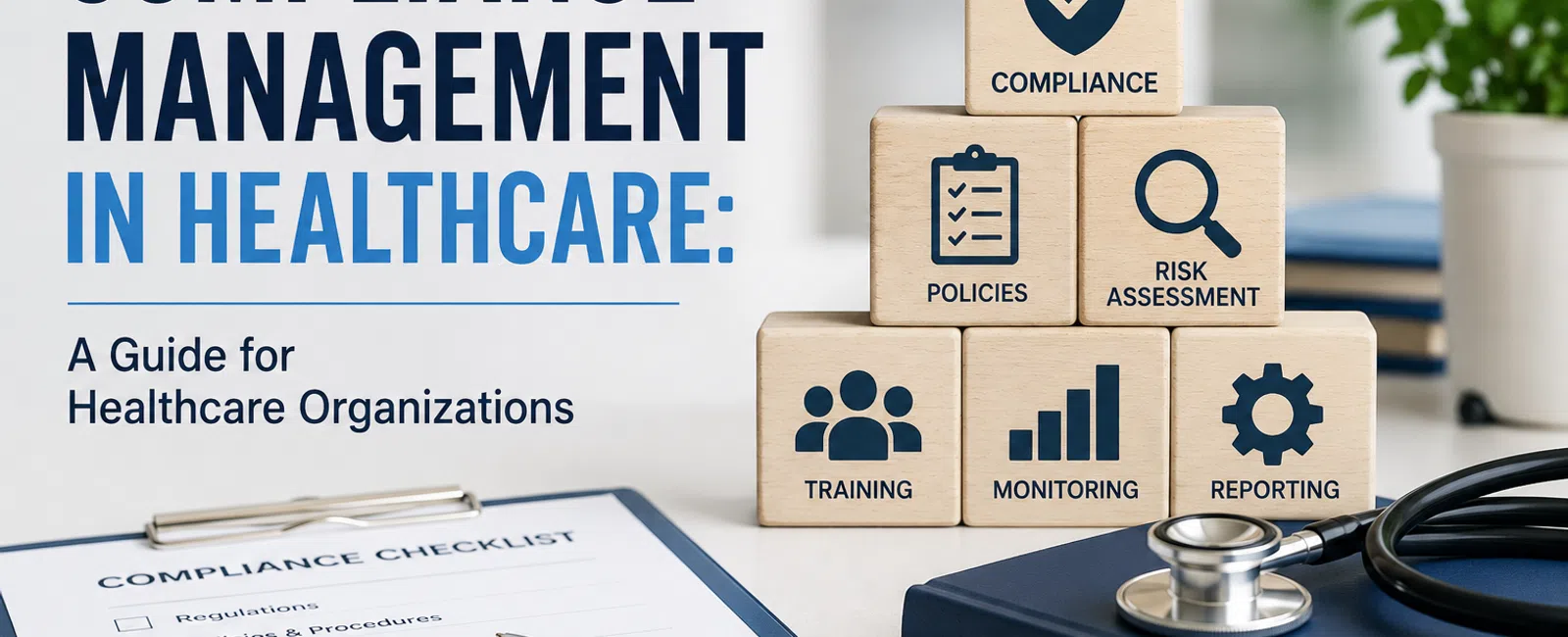
Compliance Management in Healthcare: A Guide for Healthcare Organizations
Author: Jacob Yates at Healthcare Compliance Pros
Compliance management in organizations healthcare is no
longer a background administrative task. Today, it is a central operational
discipline for healthcare providers because it helps protect patients,
reduces legal and financial exposure, and maintains trust with regulators, payors,
employees, and the public. For hospitals, clinics, group practices, and even
single provider offices, the challenge is not simply knowing the rules. The
real challenge is building a repeatable system that turns complex
requirements into policies, procedures, training, oversight, and evidence that
can withstand the scrutiny of regulators and payors.
In this article, I will explain:
· What
compliance management means within a healthcare context.
· Why it matters.
· The
essential federal regulations that shape healthcare compliance.
· How digital
tools can help streamline compliance.
· And the
best practices healthcare organizations should follow.
I will also explain why many organizations look for
specialized partners (such as Healthcare Compliance Pros) when they want a more
stream-lined, practical, and healthcare-specific solution to compliance
operations.
What Is Compliance Management in Healthcare?
Compliance management is best summarized as the
structured process of ensuring that an organization follows the laws,
regulations, and standards that apply to its operations. In practical terms, it
means identifying which requirements apply, translating them into understandable
and applicable policies and procedures, training workforce members on those policies
and procedures, monitoring whether those expectations are being met, and
documenting the entire process so the organization can demonstrate good-faith
compliance efforts.
In a healthcare setting, compliance management extends
well beyond a single regulation. It includes privacy and security obligations
under HIPAA, workplace safety obligations under the Occupational Safety and Health
Administration (OSHA), and program integrity expectations reflected in the
Office of Inspector General's (OIG's) compliance guidance.[1] It also intersects with the
Centers for Medicare and Medicaid Services' (CMS) requirements, billing
integrity, documentation standards, and state-specific obligations. Because
these areas often overlap, compliance management is best thought of as a connected
system rather than a set of separate tasks.
The OIG's General Compliance Program Guidance1 provides a useful framework for
understanding this system. It describes an effective healthcare compliance
program as one built on written policies and procedures, oversight by a
compliance officer and committee, effective training and education, open lines
of communication, internal monitoring and auditing, prompt corrective actions,
and enforcement of standards through disciplinary measures. When organizations
talk about compliance management, they are really talking about how they
operate and act on these elements on an ongoing basis.
Why Compliance Management Matters in 2026
Compliance management matters in 2026 because healthcare
organizations are operating in an environment where regulatory expectations are
more visible, enforcement risk remains real, and operational complexity keeps
increasing. And the addition of AI into healthcare brings on a whole new level
of risk. A weak compliance program can lead to breakdowns that affect patient
care, employee safety, privacy protection, reimbursement, and reputation all at
once. A strong program, by contrast, improves consistency and helps leaders
respond more confidently and efficiently when issues arise.
Patient safety is one of the clearest reasons compliance
management matters. OSHA standards that apply to healthcare, including rules
related to bloodborne pathogens and personal protective equipment, are designed
to reduce preventable harm and ensure safer working conditions. When compliance
systems are weak, training may lapse, documentation may be incomplete, and
hazards may go unaddressed for too long. Effective compliance management
reduces those gaps by making responsibilities clearer and follow-up more
consistent.
Legal and financial risk are also major concerns. CMS
explains that violations can lead to civil monetary penalties (CMPs) enforced
by Office of Civil Rights (OCR). OSHA can also issue citations and penalties
when employers fail to meet applicable standards or the General Duty Clause. The
OIG also makes it clear that healthcare entities need meaningful compliance
programs to reduce the risk of fraud, waste, abuse, and improper conduct
affecting federal healthcare programs. In short, compliance management is not
just about policies. It is a control system that helps organizations avoid
violations, respond faster to problems, and show regulators that they have
taken their compliance responsibilities seriously.
There is also an important business case to be made for
compliance management. A manual, fragmented compliance process consumes time,
creates duplicative work, and makes audits more disruptive than they need to
be. When staff members are hunting through email chains, spreadsheets, and
shared drives to find training records, policy versions, or audit logs,
compliance becomes reactive and expensive. A more structured compliance
management process improves operational performance which reduces confusion,
clarifies ownership, and gives leadership and the board a better view of risk.
Key Healthcare Compliance Regulations
A practical healthcare compliance program starts with
knowing which rules shape day-to-day operations. HIPAA remains central part of
day-to-day compliance operations because it governs how healthcare
organizations and workforce members protect and use protected health
information. The Department of Health and Human Services (HHS) broadly defines HIPAA
regulations as encompassing the Privacy Rule, Security Rule, and Breach
Notification Rule, each of which creates specific expectations for privacy
practices, safeguards for electronic protected health information (ePHI), and
response obligations when a breach occurs[2]. The OCR is ultimately
responsible for enforcing these rules and may impose CMPs when organizations
fail to comply.
OSHA is equally important because healthcare workers face
occupational risks all day, every day. OSHA's regulations and guidance apply to
issues such as bloodborne pathogens, respiratory protection, hazardous
substances, and personal protective equipment. These requirements are
especially significant in hospitals, ambulatory settings, dental practices,
laboratories, and other environments where exposure to hazards is part of regular
operations. Compliance management helps to translate these standards into training
programs, safety policies and procedures, documentation of incidents or
infractions, and corrective actions.
Corporate compliance expectations also matter, especially
for organizations that bill federal healthcare programs. The OIG's General
Compliance Program Guidance[3] provides the clearest
federal framework for how healthcare entities should structure their compliance
efforts. It addresses vital topics such as governance, risk areas,
investigations, reporting, training, policy development, and internal
oversight. Although the OIG publishes the guidance, it has become a reflection
of what the federal government views as a credible healthcare compliance
program for the HHS in general.
The current healthcare environment makes digital and
emerging technology issues more important than ever before. (Again—our friend
AI comes out to play.) Healthcare organizations are continuing to expand
telehealth, connected workflows, and participate in the electronic exchange of
information, which increases the operational importance of HIPAA privacy and
security controls. At the same time, organizations are looking more closely at
AI-enabled tools and other technologies that affect data handling,
documentation, decision support, and operational efficiency. This means
compliance leaders must pay extra attention not just to written rules, but
to how technology changes risk exposure across the organization. And the
use of AI continues to create significant risks for organizations that
do not appropriately govern its use.
This is where specialized healthcare compliance
support becomes valuable. A healthcare-specific partner can help organizations
keep policies, workflows, and training content aligned with current healthcare compliance
requirements, rather than relying on generic risk software built for broad
corporate use. That distinction matters when the regulations are as specific
and operationally demanding as HIPAA, OSHA, and OIG regulations.
Digital Solutions: Automating Compliance Management
As regulatory obligations expand, digital compliance
tools are becoming less optional and more foundational. Government guidance
does not prescribe a specific software platform, but it consistently emphasizes
the need for documented policies, effective training, internal monitoring,
prompt corrective action, and auditable oversight. These expectations are
difficult for most healthcare organizations to sustain without a full-time
compliance officer or compliance team. Spreadsheets, paper binders, and manual reminders
alone will not cut it anymore.
Automation can help significantly because it reduces
inconsistency. A digital compliance management system can automatically assign
policy attestations, track training completion and assignments, centralize
incident documentation, schedule reviews, and preserve audit trails. Instead of
relying on individual managers to remember deadlines or manually assemble
reports, organizations can build repeatable workflows that support continuous
compliance. This is particularly important in healthcare, where changes in
staffing, roles, regulations, and service lines can quickly make manual systems
outdated.
Digital tools also improve visibility. Compliance leaders
need to know which policies are overdue for review, which departments have
incomplete training, which audits remain unconducted, and which corrective
actions are still open. In a manual environment, that information is usually
delayed and fragmented. In a well-configured digital environment, it becomes
easier to monitor those issues in real time and escalate them before
they become larger problems.
However, there is a crucial difference between general
governance software and healthcare-specific compliance platforms. Generic tools
may offer broad workflow and audit functions, but they often require much more
customization to fit the expectations of federal regulators, and payors. A
healthcare-focused solution like Healthcare Compliance Pros is positioned to
reflect healthcare workflows directly, support healthcare-relevant training and
documentation needs, and align its structure to the types of audits and
oversight healthcare organizations face. That healthcare-specific fit can
reduce implementation friction and make the system more useful for compliance,
HR, safety, and operational leaders from the start.
Best Practices for Effective Healthcare Compliance Management
Effective compliance management is not built by
collecting policies and hoping workforce members follow them. Let's be honest, we
are lucky if we can get them to take training, let alone read and remember a
stack of policies. Compliance management relies on disciplined, repeatable
practices that connect requirements to daily operations. One of the most
important best practices is tailoring the program to the organization's actual
risk profile. An effective compliance program is never a "one size fits all
program." The OIG makes it clear that compliance programs should be scaled and
designed according to an organization's size, structure, and areas of risk. A
specialty clinic, a hospital system, a large multisite group practice, and a
small provider's office should not all manage compliance in the exact same way.
Tailoring an effective compliance program starts with
risk assessments and policy design. Healthcare organizations need to identify
their highest-risk areas, decide which controls matter most, and then convert
those expectations into practical policies and procedures that employees can actually
follow. Those policies should be reviewed regularly (I recommend at least
annually), updated when regulations or operations change, and connected to
clear ownership rather than sitting passively in a shared folder.
Training is another core best practice. The OIG
identifies effective training and education as a foundational part of an
effective compliance program, and healthcare organizations need more than a one-time
orientation or training session to meet that standard. Staff need at least
annual, role-appropriate education on compliance topics such as HIPAA,
workplace safety, reporting channels, and organization-specific policies.
Training should also be documented carefully so the organization can show what
was taught, to whom, and when.
Communication matters just as much as content. Employees
need a straightforward way to ask questions, raise concerns, and report
potential issues without fear of retaliation. A compliance program
becomes much more effective when staff know that concerns will be heard,
documented, investigated, and addressed.
Audit trails and monitoring are also essential.
Organizations should not wait for an outside investigator or payor to review and
discover policies are outdated or training records are incomplete. Internal
monitoring, periodic audits, and documented corrective actions help create a
continuous compliance model rather than an annual scramble. This is one of the
clearest advantages of compliance software systems: they make it easier to
preserve evidence, assign follow-up work, and show improvement over time.
Healthcare organizations should make certain the leadership
team (and board members, if applicable) is regularly informed of compliance
activities. The compliance office should ensure they receive regular compliance
reporting on topics such as:
· Key
policies and procedures
· Training completion
and attestations
· Risk
assessment results
· Reporting
channel activities
· Investigation
activities
· And corrective
actions
These are not abstract ideals to appease leaders and board
members. They are the practical signals of a functioning and effective
compliance management system.
Why Choose Healthcare Compliance Pros?
Now that is a great question! I have found healthcare
organizations often struggle because compliance work cuts across multiple
departments, yet the responsibility is dispersed and tools are often fragmented.
For smaller organizations, the struggle usually comes from the compliance
officer wearing multiple hats in the organization and never receiving training
on how to be an effective compliance officer. A specialized partner can help
close that gap by combining software, healthcare-specific compliance expertise,
and implementation support. That is where Healthcare Compliance Pros can
differentiate itself.
Healthcare Compliance Pros (HCP) was created to relieve
the burden of healthcare compliance placed on organizations. Rather than providing
broad, industry-neutral governance programs, HCP helps organizations craft a
compliance program made just for them. This matters because HIPAA, OSHA, and
OIG expectations are not generic compliance categories. They involve specific
training, documentation, oversight, and response workflows. They may provide
broad guidance and information, but the expectation has always been that a
healthcare organization's leadership, board, and compliance officer would take
that information and apply it to their organization's unique structure and way
of doing business. A healthcare-focused platform can reflect those realities
more directly and reduce the burden on compliance officers that would otherwise
have to adopt a general-purpose tool.
Another differentiator is practical alignment with the
core elements of an effective compliance program[4]. Because the OIG's
guidance emphasizes policy management, training, communication, monitoring,
investigations, and corrective action, organizations benefit from a system that
supports those activities as connected processes rather than
disconnected files and reminders.
There is also value in compliance support. Regulations
change, priorities shift, and internal workflows evolve. A strong compliance
partner does more than provide a dashboard. It helps organizations update
policies, organize documentation, improve workflows, and maintain momentum as
requirements change. For teams under constant pressure, that kind of
healthcare-specific support can be as important as the software itself.
I frequently hear new compliance officers say, "I don't
know what I don't know." Having a team
of compliance experts, only a phone call or email away can save your compliance
officer considerable time and stress from having to read and interpret
regulation on their own.
FAQs About Compliance Management in Healthcare
One common question I get asked is how often a compliance
program should be reviewed. The OIG's guidance supports regular review of
compliance policies, procedures, and risk areas, especially when regulations,
services, or operations change. An annual review is considered best practice,
but higher-risk areas may require more frequent attention.
Another question is which regulations matter most in
healthcare. For most healthcare organizations, HIPAA, OSHA, and Corporate
compliance regulations are foundational because they shape privacy, safety, and
program integrity responsibilities. The CMS and state rules may also add
additional obligations depending on the organization's structure and services.
Investors, owners, board members, and executive leaders
also ask what the consequences of noncompliance can be. HIPAA violations can
lead to OCR enforcement and CMPs, while OSHA violations can lead to citations
and fines. OIG-related failures can create broader exposure involving federal
healthcare programs, including CMPs, exclusion risks and in serious cases,
incarceration. The exact outcome depends on the facts, but the broader point is
simple: poor compliance management creates avoidable exposure, reputational
damage, and significant monetary loss.
A final common question is how automation can help a
compliance program. Automation does not replace professional judgment or
leadership oversight, but it does make compliance processes more consistent,
visible, and defensible. It helps organizations track what has been assigned,
completed, reviewed, investigated, and corrected. In compliance, evidence
matters more than intent.
In 2026, compliance management in healthcare is best understood as an operational system for protecting patients, supporting staff, reducing regulatory risk, and sustaining organizational trust. Providers that rely on disconnected manual processes will find it harder to keep up with the pace and complexity of healthcare regulation. Organizations that combine clear governance, organization-specific policies, effective training, digital workflows, and specialized support will be in a far stronger position if an auditor comes knocking. Healthcare Compliance Pros fits into that picture as a healthcare compliance-focused partner that can help turn compliance from a reactive burden into an organized, evidence-based, and effective program.
[1] https://oig.hhs.gov/compliance/general-compliance-program-guidance/
[2] https://healthit.gov/privacy-security/hipaa-basics/hipaa-providers/
[3] https://oig.hhs.gov/documents/compliance-guidance/1135/HHS-OIG-GCPG-2023.pdf
[4] https://oig.hhs.gov/compliance/physician-education/compliance-programs-for-physicians/