
Informational disclaimer: This tutorial is for general
educational purposes only and is not legal advice. It does not guarantee audit
outcomes or regulatory results. Organizations should consult qualified counsel
for legal interpretations and state-specific obligations, including state
privacy, breach notification, and records laws.
Preparing
for a HIPAA audit in 2026 means more than pulling together policies the week an
email arrives from OCR. HHS Office for Civil Rights resumed HIPAA audits in 2024
with a strong emphasis on Security Rule compliance tied to hacking and
ransomware, which means organizations should be ready to show not only written
policies but also current risk analysis, workforce training, incident response
processes, and evidence that safeguards are operating in practice.
For
most healthcare organizations, the most effective approach is a year-round
readiness program built around documentation, accountability, and continuous
improvement. That approach reflects how OCR describes the audit program itself:
a tool to assess compliance efforts, identify best practices, and surface risks
and vulnerabilities before they turn into larger enforcement problems.
What
Is a HIPAA Audit and Why It Matters in 2026?
A HIPAA
audit is a formal review conducted under OCR's HIPAA Audit Program to assess
compliance with the HIPAA Privacy, Security, and Breach Notification Rules. The
audit program is not limited to large health systems. HITECH authorizes HHS to
periodically audit both covered entities and business associates, so physician
groups, billing companies, cloud vendors, management service organizations, and
other healthcare partners all need a defensible compliance posture.
What
makes 2026 different is the combination of active OCR audit activity and
broader federal attention to cybersecurity and sensitive-data privacy. OCR
states that the current round of audits focuses on selected Security Rule
provisions most relevant to ransomware and hacking, while HHS regulatory
updates also affect how organizations should think about notice obligations,
specialized confidentiality requirements, and future Security Rule expectations.
A
useful way to think about audit readiness is to treat it as proof of
operational discipline. If an organization cannot quickly produce its risk
analysis, business associate inventory, training records, incident
documentation, and current policies, the underlying compliance program may not
be mature enough for a regulator's scrutiny even if day-to-day staff are acting
in good faith.
Key
HIPAA and Cybersecurity Standards to Know
Audit
preparation starts with the three HIPAA rule families: the Privacy Rule, the
Security Rule, and the Breach Notification Rule. Each one creates a different
kind of evidence burden. Privacy requirements often show up in policies, forms,
notices, and disclosure workflows; Security Rule requirements show up in risk
analysis, access management, system controls, and contingency planning; Breach
Notification obligations show up in incident logs, breach assessments, and
notification procedures.
Because
OCR's current audit work is centered on cyber threats to electronic protected
health information, Security Rule readiness should be a top 2026 priority. HHS
has also described a proposed Security Rule update that would make expectations
more explicit around written policies and procedures, recurring review,
testing, and technology asset inventories. That proposal is not final, so
organizations should not treat it as a present legal requirement, but it is a
strong signal of the direction federal regulators expect the industry to move.
NIST
Cybersecurity Framework 2.0 is not required by HIPAA, but it is one of the most
credible federal frameworks for organizing a modern compliance and security
program. Its six functions Govern, Identify, Protect, Detect, Respond, and
Recover fit naturally with HIPAA's risk-based structure and can help compliance
teams explain cybersecurity priorities in a way that makes sense to leadership,
IT, and auditors.
Laying
the Foundation for Audit Readiness
Strong
audit readiness begins with a practical compliance checklist, but the best
checklists are not generic. They tie each requirement to an owner, a source
document, a review date, and some form of proof that the control is actually
working. That makes the checklist useful not only for audit prep but also for
board reporting, corrective action tracking, and routine program management.
A
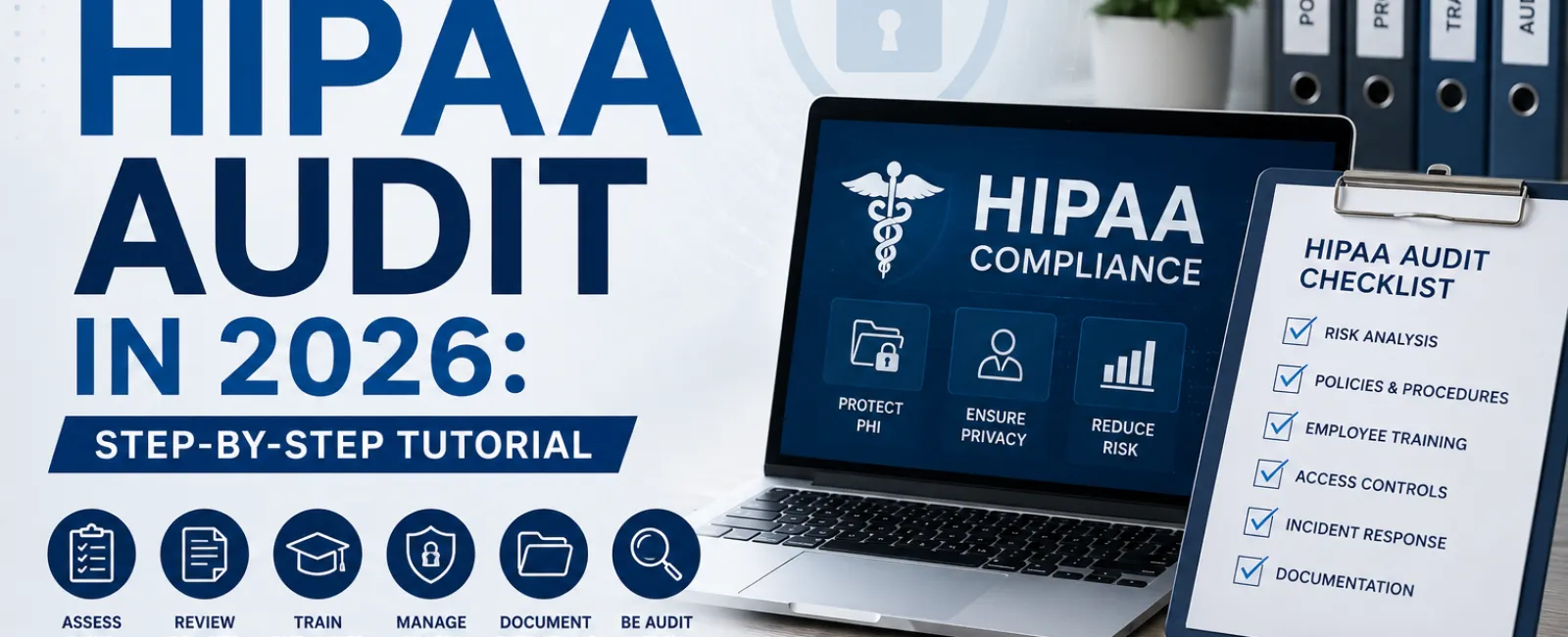
foundational checklist should include the following categories:
·
Enterprise risk analysis and risk management activities.
·
Current privacy, security, and breach notification
policies and procedures.
·
Workforce training, sanctions, and role-based
accountability records.
·
Business associate agreements, vendor oversight, and
subcontractor controls.
·
Access management, incident response, backup and
contingency planning, and documentation retention.
After
the checklist is in place, a gap analysis helps determine whether the program
is complete on paper and effective in practice. That review should compare
current controls against HIPAA requirements, OCR's audit focus, recent incident
lessons, and a recognized cybersecurity framework such as NIST CSF 2.0. In
smaller organizations, that process often reveals informal practices that staff
rely on every day but that have never been documented well enough to satisfy an
auditor.
One of
the most common weak points is documentation quality. Policies may exist, but
they are outdated, inconsistent across departments, or too generic to reflect
actual workflows. A helpful internal standard is this: if a process matters to
HIPAA compliance, there should be a current written policy, an assigned owner,
and some retained evidence that the process was carried out.
Employee
Training and Awareness for 2026
Training
is often where compliance programs look complete from a distance but weak under
closer review. OCR audit readiness requires more than a single annual
presentation. Organizations should be able to show that workforce members
receive role-appropriate training, that completion is tracked, and that updated
risks or regulatory changes are incorporated into education on a timely basis.
In
2026, role-based training should emphasize both privacy fundamentals and cyber
risk realities. Front-desk teams, clinicians, billing personnel, IT staff,
executives, and vendor-facing personnel each interact with protected health
information differently, so they should not all receive the exact same level of
detail or examples. For organizations affected by 42 CFR Part 2, workforce
training should also address the revised confidentiality and breach-related
requirements.
The
most effective training programs usually include a mix of formats rather than
relying on one annual event. For example:
·
Annual baseline HIPAA and privacy/security training.
·
Short quarterly refreshers on phishing, ransomware, or
access-control mistakes.
·
Targeted remediation training after incidents, audit
findings, or workflow changes.
Training
records matter just as much as training content. A program should be able to
produce completion reports, attestations, quiz results where used, and
documentation of follow-up when an employee misses required training or fails a
knowledge check.
Step-by-Step
HIPAA Audit Preparation Workflow
A
step-by-step workflow keeps audit readiness from becoming an abstract goal. It
gives compliance, privacy, and IT teams a repeatable operating model that can
be updated as risks, technology, and regulations evolve.
Step
1: Define scope and assign roles
Start
by determining what is in scope for the readiness effort: legal entities,
facilities, departments, information systems, cloud environments, vendors, and
high-risk workflows. Then assign accountable leads across privacy, security,
operations, HR, legal, and vendor management. A simple RACI matrix is often
enough to avoid confusion when document requests arrive.
Step
2: Conduct a baseline risk assessment
Every
organization should maintain a current risk analysis for electronic protected
health information and be able to explain the methodology used to identify
threats, vulnerabilities, likelihood, and impact. Just as important, the
organization should be able to show how that analysis informed a risk
management plan rather than sitting unused in a file share.
Step
3: Remediate risks and update safeguards
Remediation
should prioritize the issues most likely to expose electronic protected health
information or disrupt operations. In 2026, high-priority items often include
privileged access management, multifactor authentication, vulnerability
management, backup integrity, system recovery testing, and incident response
coordination.
Step
4: Maintain current documentation and logs
This is
where many programs either become audit-ready or stay perpetually reactive.
Core materials should be centralized and current, including policies, risk
analyses, BAAs, training records, sanctions documentation, access records,
incident logs, and corrective action records. Version control matters because
auditors and investigators often care whether a document was current during the
relevant period, not whether it was cleaned up afterward.
Step
5: Test controls and run mock audits
Testing
shows whether controls function outside of a policy manual. Mock audits can
include timed document requests, sample interviews, access-review validation,
restoration testing, and incident-response table-top exercises. Organizations
that regularly test these processes usually discover hidden ownership gaps
before regulators do.
Step 6:
Consider third-party review
An
external review can help when an organization has limited internal resources,
has recently grown or changed systems, or wants objective validation before
leadership attests that the program is in good shape. Independent support does
not replace internal responsibility, but it can improve accuracy, speed, and
consistency in the readiness process.
Step
7: Complete a final readiness review
Before
concluding that the organization is prepared, conduct one final check across
documents, owners, deadlines, and regulatory updates. That review should
confirm the program can quickly produce its core evidence set and has addressed
2026-effective federal requirements, including remaining Notice of Privacy
Practices changes and any applicable 42 CFR Part 2 implementation steps.
The
following table shows a simple way to organize the workflow internally:
|
Step |
Main objective |
Example proof |
|
Scope and roles |
Define audit boundaries and ownership |
RACI matrix, system inventory, entity list |
|
Risk assessment |
Identify and rank risks to ePHI |
Risk analysis report, risk register |
|
Remediation |
Reduce priority risks |
Project plans, tickets, approvals |
|
Documentation |
Keep evidence current and retrievable |
Policy library, BAA inventory, training tracker |
|
Testing |
Confirm controls work in practice |
Drill notes, audit results, restoration tests |
|
Independent review |
Validate readiness objectively |
External assessment summary |
|
Final review |
Verify readiness before audit notice |
Pre-audit checklist, leadership sign-off |
Common
Audit Pitfalls and How to Avoid Them
Most
audit problems are not caused by one dramatic failure. They are usually the
result of smaller issues that accumulated over time and were never reconciled
into a coherent program. Three issues come up repeatedly: weak documentation,
weak access governance, and weak follow-through on regulatory changes.
Common
warning signs include:
·
Missing or outdated business associate agreements.
·
Policies that do not match current systems or workflows.
·
Risk analyses that were never translated into remediation
plans.
·
Delayed deprovisioning, excessive access, or poor identity
governance.
·
Outdated assumptions about reproductive health privacy
updates or 42 CFR Part 2 compliance dates.
The
best way to avoid these pitfalls is to build an internal review rhythm.
Quarterly document checks, periodic access reviews, recurring workforce
refreshers, and at least one mock audit each year can make compliance evidence
easier to maintain and much easier to defend.
Tools,
Templates, and Resources
The
most useful audit-readiness resources are the ones that help teams act quickly
and consistently. A strong internal toolkit might include a HIPAA audit
checklist, policy inventory, training tracker, business associate agreement
inventory, incident log template, mock-audit request list, and a remediation
dashboard aligned to OCR expectations and NIST CSF 2.0 categories.
HHS HIPAA Regulatory Initiatives page
NIST Cybersecurity
Framework 2.0
Federal Register page for the 2024 reproductive health
privacy rule
Recap
Preparing for a HIPAA audit in 2026
is less about reacting to a single OCR request and more about building a
compliance program that can consistently show its work. OCR's active audit program, ongoing
federal rule activity, and the continued emphasis on cybersecurity all point to
the same reality: organizations need current risk analysis, reliable
documentation, trained staff, and controls that are tested in practice rather
than assumed to be working.
For covered entities and business
associates, the strongest position is a readiness model built around continuous
review, not last-minute cleanup. Using official resources from HHS/OCR and
vetted federal frameworks such as NIST CSF 2.0 can help organizations organize
that work in a way that is more sustainable, more defensible, and easier to
explain to leadership and regulators.
Healthcare Compliance Pros can
support that effort by helping organizations structure their audit-readiness
process, strengthen documentation, identify gaps, and build practical workflows
for training, vendor oversight, and ongoing compliance maintenance. The goal is
not to promise a specific audit outcome, but to make preparation more
organized, more efficient, and better aligned with current federal
expectations.
Want to learn more about improving your healthcare compliance program? Schedule a FREE consultation with Healthcare Compliance Pros today!