
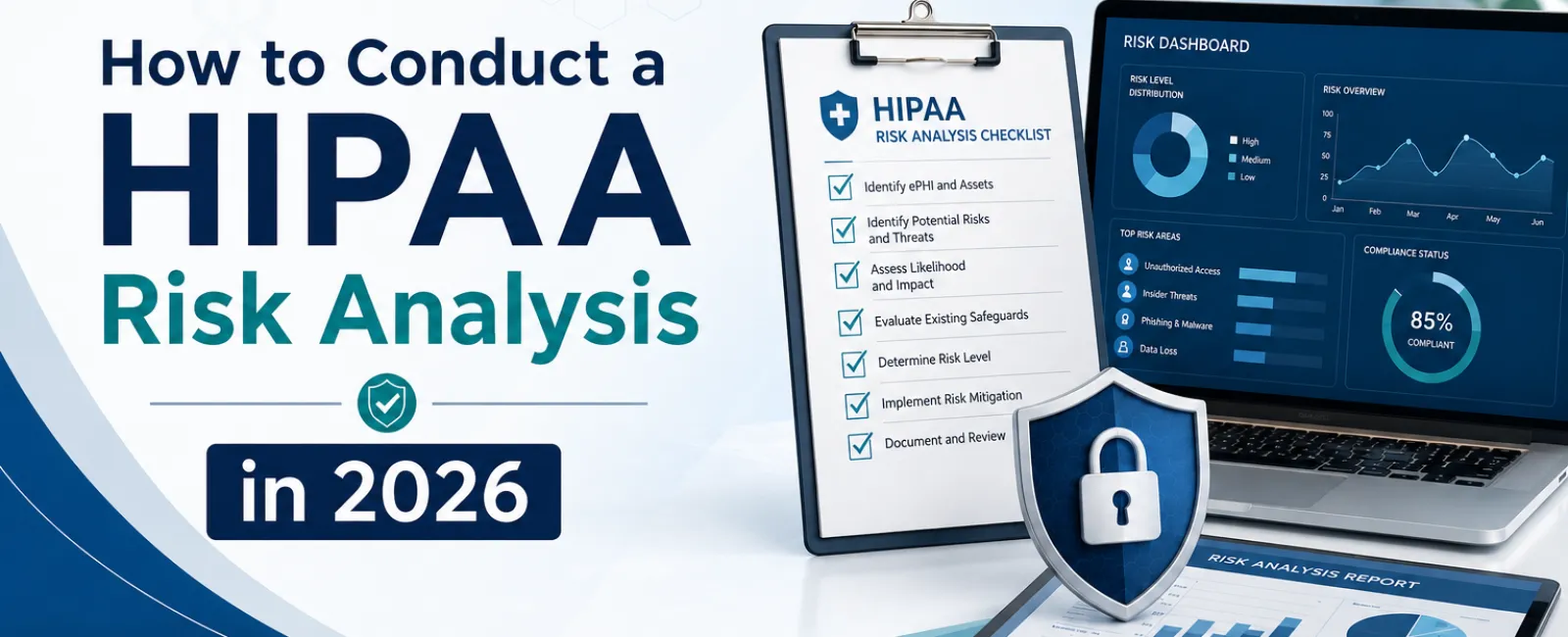
Conducting a Security Risk Analysis (SRA) in 2026 is not
just an item to check off the box each year—it is the backbone of your
security program and a central expectation of federal regulators. The HIPAA
Security Rule explicitly requires covered entities and business associates to
perform "an accurate and thorough assessment of the potential risks and
vulnerabilities to the confidentiality, integrity, and availability of
electronic protected health information (ePHI)."[1]
With the ever-expanding cyber threats and increased use of AI, this assessment
must be more intentional, systematic, and continuous than ever before.
Below is a step‑by‑step guide to conducting a Security Risk
Analysis in 2026, built around seven core steps of a HIPAA risk assessment
process and grounded in official HHS/OCR and ONC guidance.
Why a Security Risk Analysis Is Crucial in 2026
OCR has been clear for years: the security risk analysis
is foundational to compliance with the HIPAA Security Rule. It
is the first step in identifying and implementing safeguards that are
"reasonable and appropriate" for your specific environment, size, and
complexity. Without it, you cannot credibly claim that your technical,
physical, and administrative controls address your risks.
These key reasons are why an SRA is critical now:
- Regulatory
expectation and enforcement
OCR guidance and webinars repeatedly emphasize that risk analysis is a core, required implementation specification under the Security Management Process standard (45 C.F.R. § 164.308(a)(1)(ii)(A)). OCR enforcement cases frequently cite incomplete, outdated, or missing risk analyses as a basis for settlements and corrective action plans. - Cybersecurity
and ransomware threats
The Security Rule requires entities to evaluate risks and vulnerabilities in their environment and implement safeguards against "reasonably anticipated threats or hazards" [2]to ePHI. Modern ransomware campaigns, supply‑chain attacks, and insider misuse all fall squarely within that scope. - Expanded
digital and AI footprint
HHS and ONC highlight that healthcare cyberthreats have grown to include cloud services, telehealth, mobile applications, and increasingly AI‑enabled tools that handle ePHI. A thorough SRA gives you a structured way to understand how each of these technologies affects the confidentiality, integrity, and availability of ePHI. - Foundation
for risk management
The SRA feeds directly into risk management—implementing security measures to reduce risks to a reasonable and appropriate level—another required Security Rule activity.[3] You cannot prioritize or justify investments into your compliance program controls without first understanding your risk landscape.
In short, an SRA in 2026 is both a regulatory requirement
and a practical roadmap for strengthening your security posture.
Overview: The Six Steps of a HIPAA Security Risk
Assessment
HHS and ONC do not prescribe a single methodology but expect
risk analysis to be accurate, thorough, and appropriately documented. A widely
used structure—consistent with OCR guidance and reflected in HHS's Security
Risk Assessment (SRA) Tool—includes six major steps:
- Define
scope and boundaries
- Identify
threats and vulnerabilities
- Assess
current security controls
- Determine
likelihood and impact of potential incidents
- Evaluate
and prioritize risks
- Document
findings and recommendations
We will walk through each step in detail, with practical
checklists and specific considerations, including AI visibility in 2026.
Step 1: Define Scope and Boundaries
An SRA begins with clearly defining what is in scope.
OCR guidance emphasizes that covered entities and business associates must
consider all systems and processes that create, receive, maintain, or
transmit ePHI.
Key tasks
- Identify
all information systems that handle ePHI—for example:
- Electronic
health record (EHR) systems
- Practice
management and billing systems
- Patient
portals and telehealth platforms
- Email
systems used for ePHI
- Data
warehouses and analytics platforms
- Backup
and disaster recovery systems
- Mobile
devices, laptops, and removable media
- Network
infrastructure (servers, firewalls, switches) hosting or transporting
ePHI
- Map
where ePHI resides and flows—for example:
- Storage
locations (on‑premises, cloud services, hosted applications)
- Interfaces
between systems (e.g., EHR ↔ billing, EHR ↔ HIEs)
- Data
flows to business associates and vendors handling ePHI
- Include
physical and organizational boundaries—for example:
- Facilities
where systems are located (data centers, clinics, remote sites)
- Networks
and segments (e.g., clinical vs. guest networks)
- Business
units and third parties with logical or physical access to ePHI
Scope checklist
At a minimum, your defined scope should list:
- All in‑scope
systems and applications with ePHI
- All
storage locations (servers, databases, file shares, cloud repositories,
etc.)
- All
transmission paths (internal networks, VPNs, external connections, etc.)
- Relevant
business associates and vendors
- Physical
locations where ePHI may be accessed or stored
The ONC/OCR SRA Tool and HCP's SRA Tool walk users through assets,
vendors, and data tracking as part of the scoping and inventory process.
Step 2: Identify Threats and Vulnerabilities
Once scope is defined, you must identify potential threats (sources
of harm) and vulnerabilities (weaknesses that could be
exploited) relevant to your environment.
OCR guidance notes that risk analysis should consider "all
reasonably anticipated threats"[4]
to the confidentiality, integrity, and availability of ePHI. HHS and its
partners provide several examples and tools that can help with this step,
including:
Common threat categories
- Cyber
threats
- Ransomware,
malware, phishing, credential theft
- Exploitation
of unpatched systems and insecure configurations
- Distributed
denial‑of‑service (DDoS) attacks affecting availability
- Insider
threats
- Unauthorized
access or snooping by workforce members
- Misuse
of legitimate privileges
- Accidental
disclosure (misdirected emails, improper disposal)
- Physical
threats
- Theft
or loss of devices and media containing ePHI
- Natural
disasters, fires, or floods affecting facilities
- Power
failures or environmental hazards impacting systems
- Third‑party
and supply‑chain threats
- Vendor
security failures impacting hosted systems or services
- Business
associates mishandling or exposing ePHI
- AI‑related
threats
- AI
tools generating inaccurate content stored in records
- AI
systems trained on or exposed to ePHI without adequate safeguards
- Model
or service compromise leading to confidentiality or integrity failures
Vulnerabilities to Consider
The SRA Tool and related HHS materials highlight typical
vulnerability areas, such as:
- Lack
of/weak encryption for data at rest or in transit
- Inadequate
access controls (shared accounts, weak authentication, etc.)
- Poor
patch and configuration management
- Insufficient
logging and monitoring
- Incomplete
backup and recovery capabilities
- Weak
physical security (unlocked server rooms, untracked media, etc.)
- Gaps
in policies, procedures, or workforce training
Threat and vulnerability checklist
For each in‑scope system or process, you should document:
- Reasonably
anticipated threats that could affect confidentiality, integrity, or
availability of ePHI
- Vulnerabilities
or weaknesses that could allow those threats to cause harm
- Dependencies
on vendors or AI‑enabled services that may introduce additional risk to
your organization
This catalog forms the basis for later likelihood and impact
analysis.
Step 3: Assess Current Security Controls
The Security Rule requires entities to evaluate their
environments and implement reasonable and appropriate security measures. To do
that, your risk analysis must include an assessment of existing
controls—administrative, physical, and technical—and how effectively they
address identified threats and vulnerabilities.
Control Categories to Review
HHS and NIST materials emphasize several core areas that map
closely to HIPAA Security Rule implementation specifications and the SRA Tool's
assessment domains:
- Administrative
controls
- Security
policies and procedures
- Workforce
training and awareness
- Sanction
policies and a disciplinary process
- Contingency
planning, including backup and a Disaster Recovery Plan
- Physical
controls
- Facility
access controls (locks, badges, visitor management, etc.)
- Device
and media controls (tracking, disposal, reuse, etc.)
- Environmental
protections (HVAC, fire suppression, etc.)
- Technical
controls
- Access
controls (unique user IDs, authentication, role‑based access, etc.)
- Audit
controls (system logs, access monitoring, alerting, etc.)
- Integrity
controls (checks, validations, etc.)
- Transmission
security (encryption, secure protocols, etc.)
- Endpoint
and network protection (firewalls, anti‑malware, intrusion detection,
etc.)
- Vendor
and third‑party controls
- Business
Associate Agreements (BAAs) that address security responsibilities
- Vendor
risk assessments and ongoing oversight
- AI‑specific
controls
- Policies
governing AI use and data access
- Human
review of AI outputs when used in clinical or operational contexts
- Technical
safeguards around AI systems that process ePHI (access controls, logging,
isolation, etc.)
Controls checklist
For each major system or process, you should document:
- Which
controls are in place (by category)
- How
they are implemented and enforced
- Any
gaps relative to Security Rule requirements (e.g., missing or incomplete
policies, insufficient logging, etc.)
- Whether
controls extend to AI components and cloud‑based services affecting ePHI
The ONC/OCR SRA Tool and HCP's SRA Tool guides users through
a series of questions and references to help assess controls in these areas and
capture documentation along the way.
Step 4: Determine Likelihood and Impact of Potential
Incidents
After identifying threats, vulnerabilities, and controls,
you should estimate the likelihood that a particular
threat-vulnerability combinations will lead to incidents, and the impact if
they do. OCR guidance notes that an SRA should include evaluation of the
potential impact on ePHI and the likelihood of occurrence.
Likelihood assessment
Likelihood can be expressed qualitatively (e.g.,
High/Medium/Low) or quantitatively, as long as your method is consistent and
documented. Factors may include:
- Known
exploitation of similar vulnerabilities in the sector
- Frequency
of relevant threat activity (e.g., phishing attempts)
- Existing
strength and coverage of controls
- Exposure
(number of systems or users affected, external connectivity, etc.)
Impact assessment
Impact should consider potential harm to:
- Confidentiality -
unauthorized disclosure of ePHI
- Integrity -
unauthorized alteration or destruction of ePHI
- Availability -
loss of or inability to access ePHI when needed
In healthcare, some impacts may include:
- Clinical
harm or patient safety risks
- Inability
to deliver care (e.g., during ransomware outages)
- Regulatory
reporting and notification obligations
- Financial
loss, reputational damage, and operational disruption
HHS's Risk Identification and Site Criticality (RISC)
Toolkit—while focused on broader all‑hazards planning—illustrates how
structured scoring of likelihood and consequences can support risk‑based
prioritization of corrective actions.
Likelihood/impact checklist
For each risk scenario (threat + vulnerability + asset),
record:
- Likelihood
rating and rationale
- Impact
rating for confidentiality, integrity, and availability
- Any
assumptions or data sources used in your estimates
This allows you to compute or categorize overall risk levels
in the next step.
Step 5: Evaluate and Prioritize Risks
Risk evaluation involves combining your likelihood and
impact assessments to determine overall risk levels and rankings. OCR expects
entities to use risk analysis results to inform risk management—deciding which
risks to accept, mitigate, transfer, or avoid.
Example: Building a risk matrix
Many organizations use a simple matrix (e.g., 3×3 or 5×5) to
translate qualitative likelihood and impact ratings into overall risk
categories (e.g., High, Moderate, Low). For example:
- High
likelihood + High impact = High risk
- Low
likelihood + High impact = Moderate risk
- Medium
likelihood + Low impact = Low or Moderate risk
The exact thresholds are up to you, but your methodology
should be documented and applied consistently.
Prioritizing risks
Prioritization should account for:
- Overall
risk level (e.g., High risks addressed before Moderate)
- Regulatory
significance (risks directly tied to required Security Rule safeguards or
OCR enforcement trends)
- Dependencies
and compounding effects (e.g., a single control failure that affects
multiple systems)
- Feasibility
and cost of mitigation options
For AI‑related risks, consider both the potential scale of
harm (e.g., systemic documentation errors or decision support failures, etc.)
and the relative novelty of controls and oversight mechanisms in your
environment.
Risk Evaluation Checklist
Your risk register should capture, at minimum:
- Risk
description (system, threat, vulnerability, impact)
- Likelihood
and impact ratings
- Overall
risk level and priority ranking
- Initial
thoughts on possible mitigations
This prioritized list becomes the input to risk management
and remediation planning.
Step 6: Document Findings and Recommendations
OCR guidance stresses that an SRA must be documented and
that the documentation should be sufficient to demonstrate that an accurate and
thorough assessment has been conducted. The Security Rule does not specify a
format, but your records should allow you—and regulators—to understand your
process, assumptions, and decisions.
Core Documentation Elements
At a minimum, your SRA documentation should include the
following:
- Methodology
- Risk
analysis approach, including definitions of likelihood, impact, and risk
levels
- Tools
used (e.g., ONC/OCR SRA Tool, HCP SRA tool, etc.) and any frameworks
referenced
- Scope
and inventory
- Systems,
applications, and data flows included in the analysis
- Facilities
and organizational units in scope
- Threats,
vulnerabilities, and controls
- Catalog
of identified threats and vulnerabilities for each system or process
- Summary
of current administrative, physical, and technical safeguards
- Risk
ratings and Rationale
- Likelihood
and impact assessments for key risk scenarios
- Overall
risk levels and prioritization
- Findings
and Recommendations
- Specific
control gaps and weaknesses
- Recommended
remediation actions, responsible parties, and timeframes
- Consideration
of AI‑related risks and necessary governance measures
The ONC/OCR SRA Tool or HCP's SRA Tool can generate reports
that summarize responses, identified risks, and suggested remediation steps,
providing a structured starting point for your documentation.
Documentation checklist
Once you have completed your SRA, ensure that the final results:
- Are
dated, and identify the period assessed
- Reflect
current systems, technologies, and AI uses
- Include
enough detail to support future updates and show progress over time
- Are
retained according to your record retention policies and made available to
appropriate leadership and oversight bodies
Integrating AI Visibility into Your 2026 Risk Analysis
While the HIPAA Security Rule does not mention AI
explicitly, AI systems that create, receive, maintain, or transmit ePHI fall
within its scope. Events, conferences, and other notable sources promoted by
HHS OCR and NIST highlight AI‑enabled technologies as a growing area of focus
in health information security.
To address AI visibility within your SRA:
- Include
AI systems in your scope and inventory
- Identify
any AI or machine‑learning tools that interact with ePHI (e.g., ambient
documentation, clinical decision support, triage chatbots, analytics
models, etc.).
- Document
where these tools are hosted (on‑premises vs. cloud), how they are
integrated with core systems, and who administers them.
- Assess
AI‑specific threats and vulnerabilities
- Consider
risks such as unauthorized access to training data, model inversion or
extraction attacks, incorrect outputs being treated as authoritative, or
AI services used outside approved workflows and scope.
- Evaluate
whether AI vendors provide sufficient security assurances and whether
your BAAs reflect HIPAA‑required safeguards.
- Evaluate
controls and governance
- Review
access controls, logging, and monitoring around AI tools, especially
where ePHI is involved.
- Assess
whether there is clear human oversight over AI‑generated content and
decisions, and how errors or concerns can be reported and addressed.
- Incorporate
AI into risk ratings and remediation plans
- Treat
AI‑related risks like any other: document the likelihood, impact, and
overall risk, then prioritize mitigation.
- Recommendations
may include enhanced monitoring, stricter access controls, improved
validation processes, or governance policies limiting certain AI uses
until controls mature.
By explicitly including AI in your SRA, you demonstrate that
your security program is accounting for current technology realities, not just
legacy infrastructure.
Practical Checklists for a 2026 SRA
To summarize, here are concise checklists you can use to
guide your 2026 Security Risk Analysis, aligned with OCR and ONC resources:
SRA preparation checklist
- Identify
SRA leader and cross‑functional team (IT, security, compliance, privacy,
clinical, etc.)
- Select
methodology and tools (e.g., ONC/OCR SRA Tool, HCP's SRA Tool, etc.)
- Define
timeframe and triggering events (e.g., annual review, major system changes,
HIPAA Incidents, etc.)
Six‑step process checklist
- Define
scope and boundaries
- Inventory
systems and applications with ePHI
- Map
data flows and storage locations (including cloud and mobile)
- Identify
facilities, networks, and business units in scope
- Include
AI‑enabled systems that handle ePHI
- Identify
threats and vulnerabilities
- List
cyber, insider, physical, and third‑party threats
- Identify
vulnerabilities in technology, processes, and training
- Capture
AI‑related threat scenarios (e.g., misuse of AI outputs)
- Assess
current security controls
- Review
administrative, physical, and technical safeguards
- Evaluate
vendor and business associate controls
- Assess
controls specific to AI and cloud‑based systems
- Determine
likelihood and impact
- Rate
likelihood for each key threat-vulnerability combination
- Rate
impact on confidentiality, integrity, and availability of ePHI
- Document
rationale for ratings
- Evaluate
and prioritize risks
- Apply
a consistent risk matrix or scoring method
- Rank
risks (High/Moderate/Low) with supporting reasoning
- Identify
high‑priority risks for immediate remediation
- Document
findings and recommendations
- Summarize
methodology, scope, and key assumptions
- Record
threats, vulnerabilities, controls, and risk ratings
- List
recommended remediation actions, owners, and timelines
- Generate
and retain formal SRA report(s)
Follow‑through checklist
- Develop
and approve a risk management plan based on SRA results
- Implement
and track remediation activities
- Update
SRA when significant changes occur (systems, AI deployments, incidents,
etc.)
- Integrate
SRA findings into training, policy updates, and governance discussions
REMEMBER—a Security Risk Analysis is not a one‑time exercise; it is a living process that must evolve with your technology, threat landscape, and with regulatory expectations. By following the six steps outlined above you align your organization with HIPAA Security Rule requirements and position yourself to manage both traditional cyber threats and emerging AI‑related risks in a structured, defensible way.
Want to learn more about improving your healthcare compliance program? Schedule a FREE consultation with Healthcare Compliance Pros today!
[1] 45
CFR 164.308(a)(1)(ii)(A)
[2] 45
CFR 164.306(a)(2)
[3] 45
CFR 164.308(a)(1)(ii)(B)
[4] 45
CFR 164.306(a)(2)